Explore the Free Neurosomatic Awareness Programme
Your Window of Tolerance
Some days you can handle almost anything. A difficult conversation, a tight deadline, bad news or an unexpected problem may leave you stressed, but you can still think clearly, stay connected to yourself and respond rather than react. Other days, something relatively small can tip you into anxiety, overwhelm or complete shutdown. It can feel like the same person has very different capacities from one day to the next.
That changing capacity is one way of understanding the window of tolerance. It describes the range of nervous system activation in which you can remain sufficiently present, connected and able to respond to what is happening, even when you are uncomfortable. Understanding your window of tolerance can help explain why situations that feel manageable one day can feel overwhelming on another.
What Is the Window of Tolerance?
The window of tolerance is the range of nervous system arousal in which you can function relatively well. Inside it, you can think, feel, connect and make choices. You don't necessarily feel calm. You can be worried, frustrated, sad or afraid and still remain present enough to stay with what you're experiencing.
This is an important distinction. Your window of tolerance is not simply the zone where everything feels safe and comfortable. You can experience anxiety or discomfort and still remain within your window. The difference is that you can stay with the experience without being completely swept away by it.
The term was introduced by psychiatrist Dan Siegel in 1999 and has since become widely used in trauma and nervous system work. The basic idea is that there is a range of arousal in which we have the greatest access to our ability to think, feel and respond. Outside that range, the nervous system is more likely to move into protective states.
It helps to picture it. In the diagram below, the central zone represents your window of tolerance. Above it, activation rises into hyperarousal. Below it, activation drops into hypoarousal.
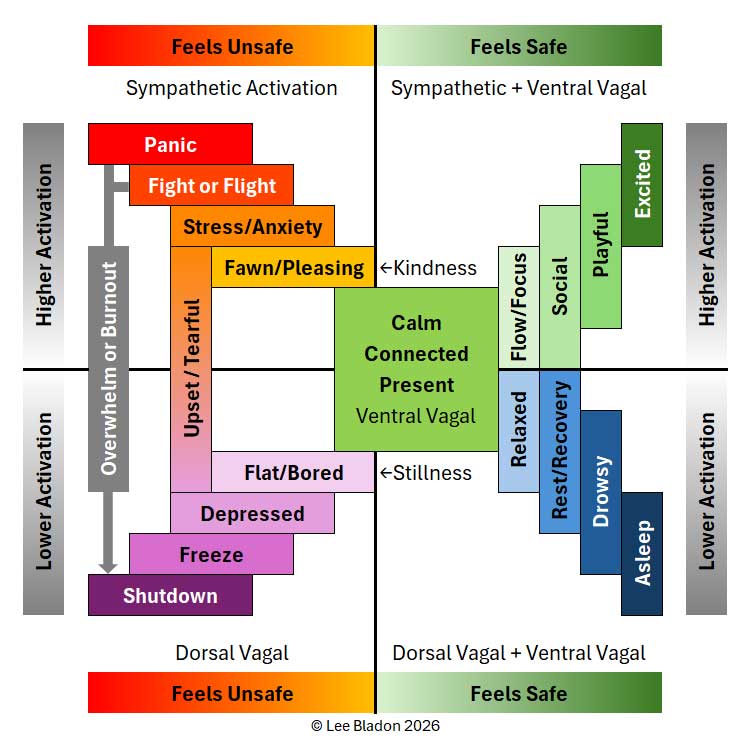
One of the most useful things to notice is that being inside your window doesn't mean feeling perfectly calm. You can be uncomfortable and still be present. You can feel fear and still choose how to respond. You can feel anger without being completely consumed by it. You can feel sadness without needing to escape it. The capacity to remain present with what you're experiencing is at least as important as how pleasant the experience feels.
What Happens Outside the Window?
When activation moves beyond your current capacity, the nervous system becomes more focused on protection. This can happen in two broad directions.
Hyperarousal: Too Much Activation
When activation rises above the top of your window, you move towards hyperarousal. This is where fight-or-flight responses become more dominant. You may experience anxiety, panic, racing thoughts, irritability, anger, restlessness or a powerful urge to act, escape or regain control. Your body may feel tense and braced, your attention may narrow, and thinking clearly can become much harder because so much of your system is focused on dealing with what it perceives as a threat.
Hypoarousal: Too Little Activation
When activation drops below the bottom of your window, you move towards hypoarousal. This can feel like numbness, heaviness, exhaustion, disconnection, low mood, brain fog or a sense of being far away from yourself and your surroundings. From the outside, this state can sometimes look peaceful because there is little obvious emotional activity, but numbness isn't the same as calm. The system may simply have moved in the opposite direction because the level of activation became too much to stay with.
Both hyperarousal and hypoarousal can be understood as protective responses. They are not signs that you've failed. They are ways your nervous system has learned to respond when your current capacity is exceeded.
Why Does the Window of Tolerance Narrow?
Your window of tolerance isn't fixed. It changes from day to day. Poor sleep, ongoing stress, hunger or illness can temporarily reduce your capacity, which is one reason something that feels manageable when you're well rested can feel completely overwhelming when you're depleted.
But there can also be a deeper reason why someone's baseline window becomes narrower. Our nervous system learns from experience. If you repeatedly experienced situations in which you felt unsafe, overwhelmed, rejected, criticised or unable to cope, your system may have learned to become more sensitive to signs of threat. This is part of what it means to have a dysregulated nervous system that is calibrated to the past rather than the present.
This is one way of understanding the relationship between the window of tolerance and trauma. When the nervous system has learned to stay on guard, less activation may be needed to push you towards the edge of your window. Something that barely registers for another person may trigger a much stronger response in you.
That doesn't necessarily mean the response is irrational. It may make more sense when you understand what your nervous system has learned to expect.
Why Can Your Reactions Feel Bigger Than the Situation?
This is one of the most useful things the window of tolerance model can help explain. Imagine someone makes a slightly critical comment. Objectively, it may be a small interaction, but perhaps your body suddenly becomes tense, your mind starts racing and you feel exposed, rejected or ashamed. You may want to defend yourself, withdraw or make sure the other person isn't disappointed in you.
You may even know intellectually that the situation isn't a big deal, yet your reaction feels much bigger than the event itself.
The window of tolerance gives us another way to understand this. The present situation may have activated a nervous system that has already learned to associate certain cues with threat. The response isn't necessarily about the present alone. Something about the present may be touching something the system learned in the past.
That distinction matters because it changes the question. Instead of only asking, "How do I calm myself down?", we can also ask, "What has my nervous system learned to expect here?"
The Good News: Your Window Isn't Fixed
Your window of tolerance can change. You can gradually develop a greater capacity to remain present with sensations, emotions and experiences that previously felt too much.
But this doesn't happen by forcing yourself through overwhelming experiences. If you push yourself far beyond your capacity, you may simply confirm to your nervous system that the experience really is too much. The work is usually much gentler.
You meet a manageable amount of discomfort, stay present with it, allow your system to experience that you can remain there, and then return towards greater ease. Over time, those repeated experiences can begin to expand the edges of what you can tolerate.
The diagram below illustrates this movement from a narrow window towards a wider one.

The aim isn't to become someone who never feels anxious, angry, frightened or overwhelmed. It's to become someone who can experience more without automatically being taken over by it.
That is a very different goal.
How Do You Widen Your Window of Tolerance?
The first step isn't necessarily learning another technique. It's learning to notice where you are. Most of us don't notice that we're moving towards the edge of our window until we're already there. We live in our thoughts and only recognise what is happening once the reaction has become obvious.
Your body often knows earlier. Your jaw tightens, your breathing changes, your stomach contracts, your chest becomes tense, your thoughts speed up, or you feel an urge to fix something, escape, shut down or make someone else happy. These can all be clues that activation is rising.
The earlier you notice, the more choice you have. Catch rising activation at five out of ten and you may still have several options available to you. Notice it at nine out of ten and you're much more likely to be caught inside the response.
Learn to Notice Your State
Regularly checking in with your body can help you recognise your state before it becomes overwhelming. A simple body scan can help. Rather than trying to change anything, slowly bring your attention through your body and notice what is already there. Where is there tension? Where do you feel movement? Where do you feel settled? Where do you feel activated?
The point isn't to produce a particular state. It's to become more aware of the state you're already in.
Aim for Presence, Not Numbness
One of the easiest mistakes to make is confusing the absence of emotion with regulation. You may feel very little and assume you're calm, but genuine regulation isn't necessarily about feeling less. It can mean having enough capacity to feel more clearly without being overwhelmed by what you feel.
A wider window doesn't mean becoming emotionally numb. It means becoming more able to remain present.
Work at the Edges
You don't widen your window by constantly pushing yourself to the point of overwhelm. Instead, work with experiences that are challenging but manageable. Feel a little discomfort, stay present, notice what happens, allow yourself to settle, and then gradually explore a little more.
This is where approaches such as titration, working with difficult material in small, tolerable amounts, and pendulation, moving gently between activation and greater ease, can be useful.
Build Safety Through Experience
Knowing intellectually that you're safe isn't always enough. Your nervous system learns through experience. That means widening your window is partly about giving yourself repeated experiences of being present with difficulty and discovering that you can remain there.
You notice the sensation, allow the emotion and stay connected to your body without immediately needing to fix, suppress or escape what you're experiencing. Gradually, the system can begin to discover that it is possible to feel something difficult and remain present with it.
Your Window of Tolerance Can Become More Flexible
A wider window doesn't mean that you will never move into hyperarousal or hypoarousal again. Life will still affect you. There will still be days when you're tired, stressed or emotionally stretched.
The difference is that you may have more room before you reach the edge, more awareness when you're approaching it, and more capacity to return when you do move outside it. That flexibility is important.
The goal isn't perfect regulation. It's greater capacity, awareness and choice.
And this is where the window of tolerance becomes part of a much bigger picture.
The Window of Tolerance Is Only Part of the Picture
The window of tolerance can help you understand where you are, but it doesn't necessarily explain why your nervous system responds the way it does.
Why does one person become anxious when someone withdraws while another barely notices? Why does criticism trigger one person into overthinking while another can simply take it on board? Why does uncertainty feel manageable to one person but deeply threatening to another?
To understand that, we need to look beyond regulation and towards the patterns, beliefs, emotions and experiences that have shaped the nervous system in the first place. This is the deeper question explored in why a dysregulated nervous system is often calibrated to the past. It also helps to see where the window sits among all your nervous system states, which is laid out in The Nervous System Map.
This is where awareness becomes so important. The more clearly you can recognise what is happening in your body, your emotions and your patterns, the more opportunity you have to work with those responses rather than simply being carried by them.
Learning to Work With Your Nervous System
The window of tolerance is one piece of a larger picture. It's a way of understanding how much activation you can currently stay present with, when your system moves towards protection, and how your capacity can gradually change.
That is exactly what the free Neurosomatic Awareness Programme is designed to help you explore. It takes you through understanding your nervous system, recognising your different states, developing somatic awareness and beginning to understand the deeper patterns and conditioning that shape how you experience yourself and your life. The programme is free and self-paced.
If this resonated, the full nervous system development programme goes deeper: 10 modules, 35 video lessons, and guided audio practices to help you build lasting nervous system awareness. It's completely free.