Dysregulated Nervous System
We hear a lot about nervous system dysregulation these days. Anxiety, overwhelm, hypervigilance, shutdown and emotional reactivity are often described as signs that the nervous system has become dysregulated. But what if there is another way of understanding what is happening? What if a dysregulated nervous system isn't necessarily broken, but incorrectly calibrated? By this, I mean a nervous system whose sensitivity has been shaped by the past and which may continue responding to perceived threat even when there is no immediate danger in the present.
Your nervous system doesn't respond only to what is objectively happening. It also responds to what it perceives is happening. A situation can be safe in the present, yet your system may still interpret it as threatening because something about it resembles an experience that was unsafe in the past. This distinction can change the way we think about anxiety and many other forms of emotional suffering.
Perceived Threat Isn't Always Actual Threat
Imagine someone sends you a short, ambiguous message. There may be nothing objectively threatening about it, but perhaps you suddenly feel anxious. You start analysing the wording, wondering whether you've done something wrong, replaying the conversation and thinking about what you should say next. Your nervous system has detected something that it interprets as potentially threatening. The problem isn't necessarily that the system is malfunctioning. It may be doing exactly what it learned to do. The question then becomes: why has it become so sensitive to particular cues?
One way of understanding nervous system dysregulation is as an incorrect sensitivity setting. The threshold for detecting threat has become lower, so the system is more likely to respond to perceived danger even when the present situation isn't actually dangerous. This can contribute to a narrower window of tolerance. It may take less to push you into anxiety, overwhelm, hypervigilance or shutdown, and it may take longer to return to a settled state.
Signs of a Dysregulated Nervous System
The signs of a dysregulated nervous system can look very different from one person to another. But rather than being a random collection of symptoms, they can be understood as different ways the nervous system responds when it detects a threat, whether that threat is actually present or not.
- For some people, the system is more easily pushed into activation. You might become anxious when someone doesn't reply to a message, feel intensely unsettled by uncertainty, become hypervigilant in relationships, or find yourself overthinking every possible outcome. Small mistakes may trigger disproportionate anxiety, while criticism or the possibility of rejection can feel far more threatening than the situation itself might seem to warrant.
- For others, the response can move in the opposite direction. When activation becomes overwhelming, the system may shift towards shutdown or withdrawal. You might feel numb, exhausted, disconnected, foggy or unable to engage with the world around you.
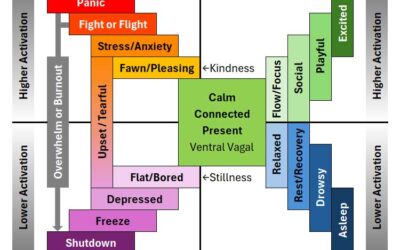
- Many people experience both. You might spend part of the day feeling wired, restless and unable to switch off, then later find yourself depleted, withdrawn or emotionally flat. Seeing where these different states sit in relation to one another can make them much easier to recognise, which is exactly what The Nervous System Map lays out.
There can be physical signs too, such as muscle tension, changes in energy, disrupted sleep or digestive symptoms. But the more useful question may not simply be "Which symptoms do I have?"
It may be: "What is my nervous system interpreting as a threat?"
And perhaps even more importantly: "Is that threat actually present now, or is something in the present activating an old pattern from the past?"
Seen in this way, the signs of a dysregulated nervous system can become more than a checklist of symptoms. They can become clues to how your nervous system has learned to interpret the world.
Where Do These Settings Come From?
There isn't always one obvious event that explains them. When we think about trauma, we often imagine something dramatic or catastrophic. But the experiences that shape us can also be much smaller and more repetitive.
A child may repeatedly feel unseen, misunderstood, dismissed, criticised, rejected or emotionally unsupported. They may learn that their needs are inconvenient, that their feelings are too much, that mistakes are dangerous, or that being accepted depends on behaving in a particular way. Any one of these experiences may seem relatively minor in isolation, but layer upon layer, they can shape how a developing nervous system learns to interpret the world.
A child doesn't have the capacity or perspective of an adult. They can't easily step back and think, "My parent is struggling to respond to me because they are overwhelmed themselves." Instead, they may arrive at much more personal conclusions: I'm not important. I'm not good enough. I'm too much. I'm not safe. There's something wrong with me. These painful conclusions can become deeply embedded in the developing sense of self.
From Painful Feelings to Protective Patterns
Once those underlying feelings and beliefs are established, we naturally begin trying to protect ourselves from them. Different people do this in different ways.
- Some learn to prove the belief wrong. They become highly driven, perfectionistic, successful or endlessly helpful, working hard to become good enough, useful enough or impressive enough to finally feel worthy.
- Others begin to live as though the belief is true. They withdraw, give up, avoid opportunities or become resigned to feeling that something is fundamentally wrong with them.
- Others try not to feel any of it at all. They keep busy, overthink, distract themselves, numb themselves, disconnect or avoid whatever might bring those feelings to the surface.
These strategies can be remarkably effective in the short term. They can also become deeply ingrained, until eventually they operate almost automatically.
Why Do the Patterns Continue Into Adulthood?
This is where the idea of calibration becomes particularly useful. The nervous system learned from your earlier experiences, but simply getting older doesn't automatically update everything it learned.
You may now be an adult with far more capacity, understanding, perspective and choice than you had as a child. But part of your system may still be operating according to an older set of assumptions. You may still feel that you need to watch for rejection, avoid mistakes, keep people happy, stay in control or prevent yourself from feeling too much.
The original circumstances may have changed, but the underlying settings can remain. This is why you can know intellectually that you're safe and still feel unsafe. You can know that someone else's opinion doesn't define your worth and still find yourself desperately wanting their approval. You can know that you don't need to be perfect and still feel intense anxiety when you make a mistake.
Understanding the pattern is valuable, but understanding it doesn't necessarily change the settings.
Why Awareness Alone Isn't Always Enough
You can become incredibly self-aware and still find yourself repeating the same loops. You might know exactly why you overthink, understand your childhood, recognise your triggers and even be able to explain your behaviour to someone else in great detail. Yet when the trigger appears, the old response can still happen anyway.
That's because the pattern isn't only an idea in your mind. It is also something you experience through your body, emotions and nervous system. The conscious mind can understand something while an older part of the system continues responding from the past.
This is one reason I don't think healing is simply about learning more. Sometimes the work is less about finding another explanation and more about becoming aware of what is actually happening inside you as it happens.
Recalibration Rather Than Retraining
This is where I use the word recalibration. Recalibration doesn't mean that your nervous system is broken and needs to be retrained. It means that an already capable system may have learned to respond to the world through settings that were shaped by earlier experiences.
The goal isn't to eliminate your nervous system's ability to detect threat. That would obviously be neither possible nor desirable. The aim is to gradually help the system become more responsive to the reality of the present, rather than automatically organising experience around the past.
In other words, the movement is from the past to the present, from automatic reaction to conscious awareness, and from old assumptions to current reality.
So How Do We Begin to Recalibrate?
For me, this begins with reconnecting with the body and emotions rather than trying to think our way out of every experience. What happens in your body when you feel criticised? What happens when someone becomes distant? What do you notice before you start overthinking? Where do you feel anxiety? What emotion is underneath the urge to control, avoid, please or withdraw? What are you expecting to happen? And perhaps most importantly, is this actually happening now, or is something from the past being activated?
As you become more aware of these processes, you begin to create a little more space between the trigger and the automatic response. You can become more present with what you're experiencing rather than immediately trying to escape it, suppress it or fix it. Over time, that can create an opportunity for the nervous system to learn something new. This is also how you gradually widen your window of tolerance, the range in which you can stay present without being pulled into a protective state.
Your Adult Capacity Is Different
One of the most important things to recognise is that you are not the child you once were. You may now have far more resources, understanding, choice and perspective. You can set boundaries, leave situations that aren't healthy, ask for support, speak up and choose who you spend time with. You can understand emotions in ways you couldn't possibly have understood them as a child. The difficulty is that having those capacities intellectually doesn't always mean your nervous system fully experiences them. That's where recalibration comes in.
Rather than simply telling yourself, "I'm safe now," you gradually develop the capacity to experience yourself as safe in the present. Rather than telling yourself, "I don't need everyone's approval," you begin to experience what it is like to tolerate someone being disappointed in you without abandoning yourself. Rather than telling yourself, "I can handle this feeling," you begin to actually feel it while remaining present enough to discover that you can.
From Living on Autopilot to Living With Awareness
Much of our suffering can come from patterns that operate outside our conscious awareness. We react before we understand, protect before we feel, and repeat before we question. But once we begin bringing conscious awareness to our bodies, emotions, beliefs and protective patterns, something starts to change. We can begin to see that a pattern is not an identity. Anxiety isn't necessarily who you are. People-pleasing isn't who you are. Overthinking isn't who you are. Shutdown isn't who you are.
These may be learned responses that once served a purpose. And if they were learned, they may not have to govern your life forever.
Recalibrating From the Past to the Present
I don't think healing a dysregulated nervous system is simply about becoming better at regulating ourselves when we're distressed. Regulation matters, but underneath the question of regulation is another question: why is my system responding this way in the first place?
What did it learn? What is it expecting? What is it protecting? What belongs to the past? And what is actually happening now?
For me, this is the deeper meaning of nervous system recalibration. It's about gradually helping your system recognise the reality of the adult life you're living now, rather than continuing to respond as though you're still living inside the circumstances in which those old patterns were formed.
You are not broken. Your nervous system may simply be working from an outdated map.
Sometimes healing begins when we stop trying to force the system to change and start becoming curious about what it learned, why it learned it, and what it needs in order to discover that the present is different from the past.